ACID Properties in DBMS
ACID ensures reliable database transactions.
Atomicity : A transaction must either complete entirely or not execute at all.
Consistency : The database must remain valid before and after the transaction.
Isolation : Multiple transactions execute independently without interference.
Durability : Once a transaction is committed, it remains permanent even after a system crash.
Normalization in DBMS
Normalization is a technique used to reduce redundancy and improve data integrity.
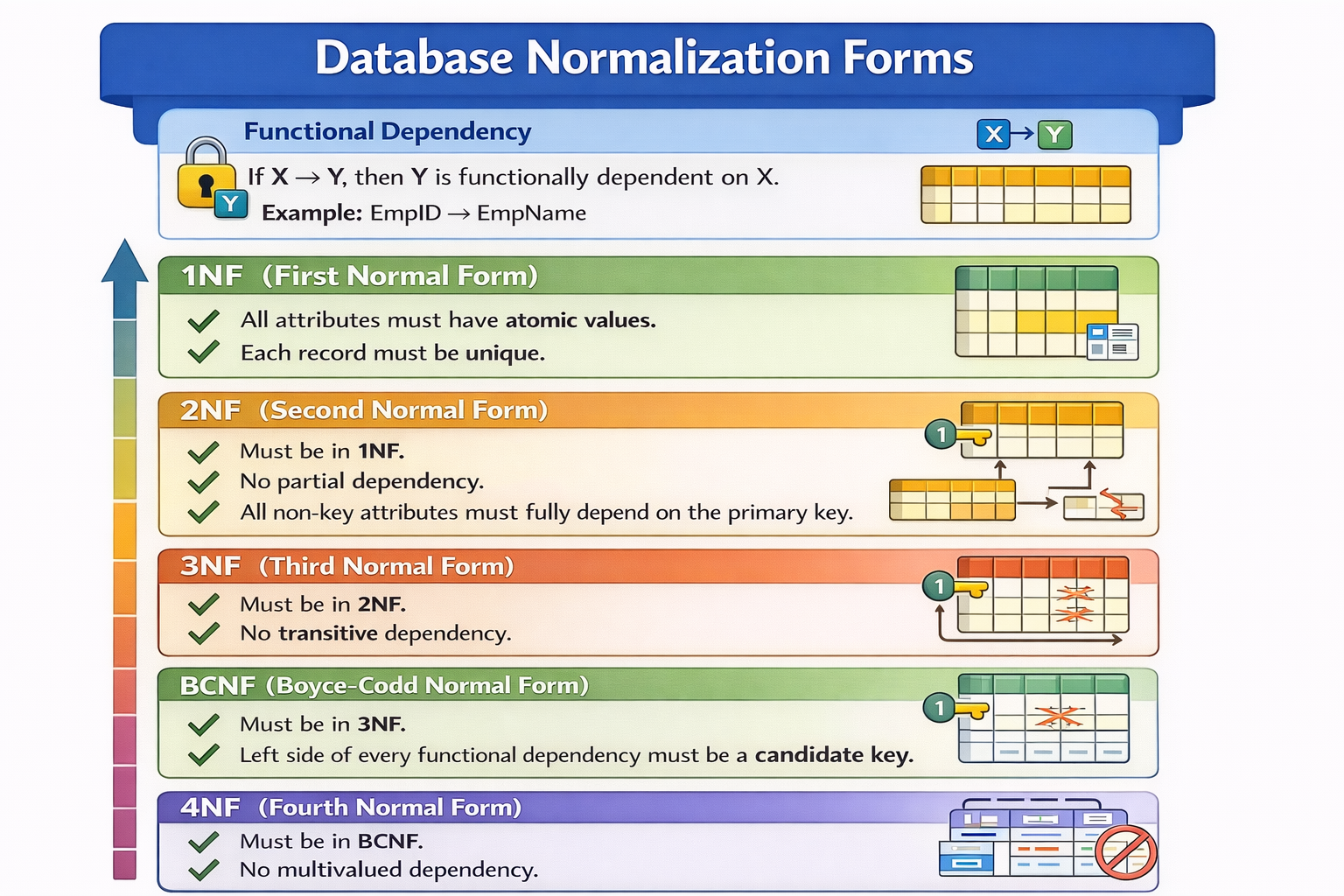
Functional Dependency
If X → Y, then Y is functionally dependent on X.
Example: EmpID → EmpName
1NF (First Normal Form)
- All attributes must have atomic values.
- Each record must be unique.
2NF (Second Normal Form)
- Must be in 1NF.
- No partial dependency.
- All non-key attributes must fully depend on the primary key.
3NF (Third Normal Form)
- Must be in 2NF.
- No transitive dependency.
BCNF (Boyce-Codd Normal Form)
- Must be in 3NF.
- Left side of every functional dependency must be a candidate key.
4NF (Fourth Normal Form)
- Must be in BCNF.
- No multivalued dependency.
Keys in DBMS
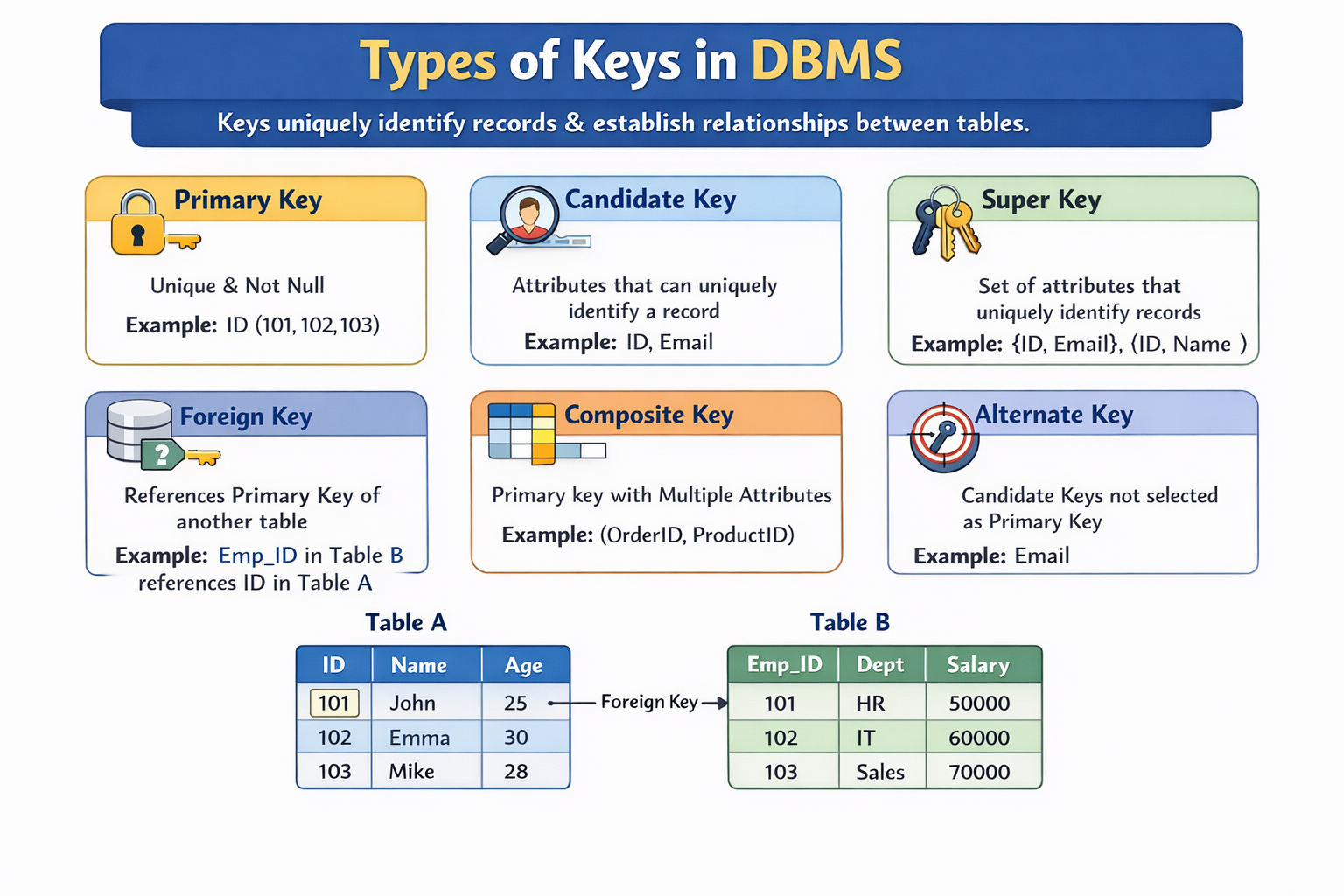
Keys are used to uniquely identify records and establish relationships between tables.
Primary Key : Unique and not null.
Candidate Key : Attribute(s) that can uniquely identify a record.
Super Key : A set of attributes that uniquely identify records.
Foreign Key : References the primary key of another table.
Composite Key : Primary key consisting of multiple attributes.
Alternate Key : Candidate keys not selected as primary key.
 ————————————————————————
Master DBMS step by step with this structured series.